


AI chatbots and voice agents under the EU AI Act
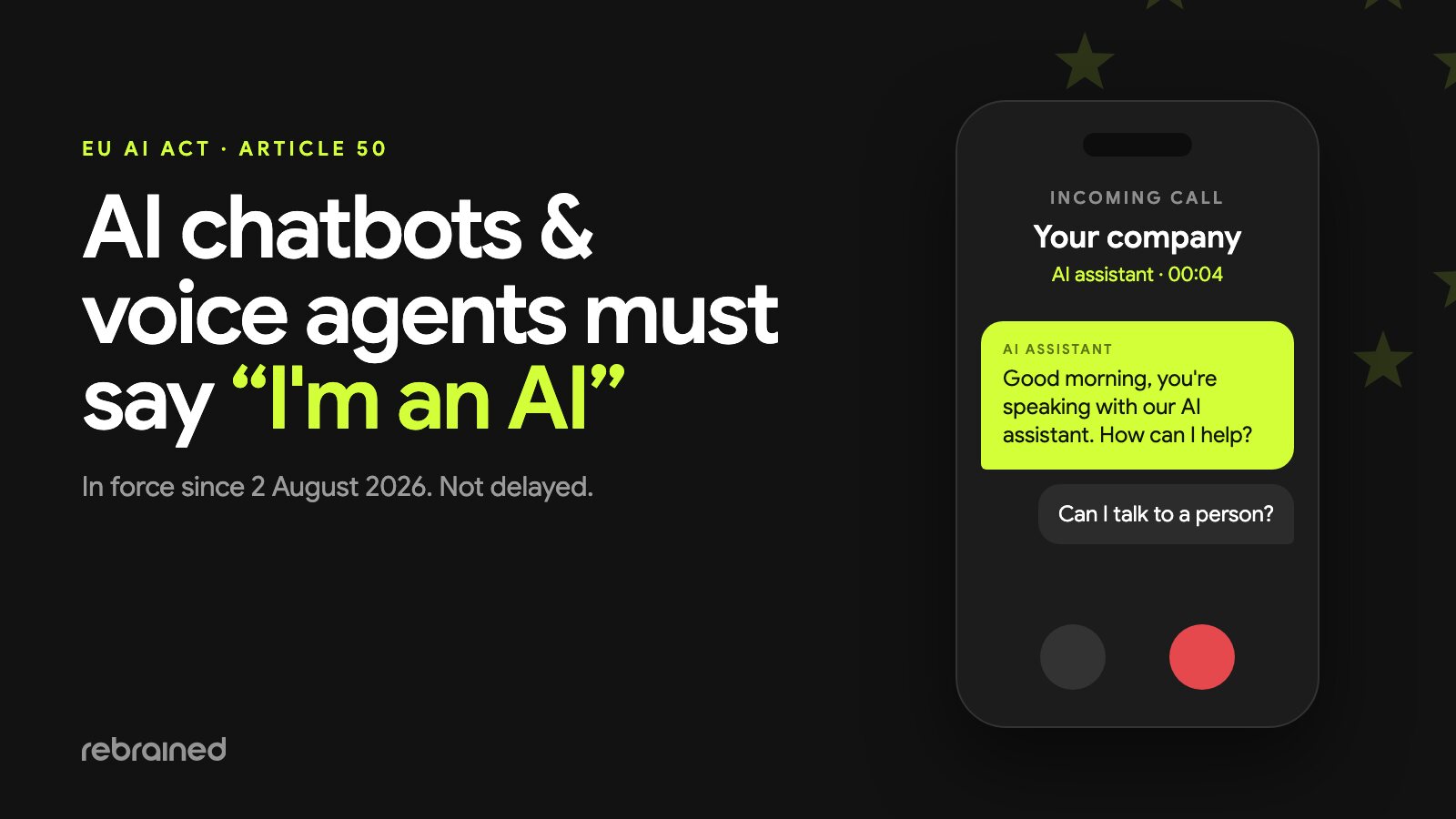
If your website has a chat assistant or an AI answers your phone, one rule of the EU AI Act already applies to you. It has applied since 2 August 2026.
A lot of companies think the AI Act was postponed. Part of it was. This part was not. Here is what the rule says, who it applies to, and what to change, in plain words.
This is a practical summary from people who build these systems, not legal advice. For your specific case, ask a lawyer.
The rule in one sentence
When a person talks to an AI system, they must be told it is an AI, clearly, at the latest at the first interaction, unless it is already obvious.
That is Article 50 of the AI Act, the transparency rules. It covers chat assistants, voice agents on the phone and AI agents that talk to people directly. “Obvious” is a high bar: a chat window called “Sarah” with a smiling photo is not obvious.
What the delay changed, and what it did not
In 2026 the EU passed the Digital Omnibus, a package that changed the AI Act timeline. It moved:
- the rules for high-risk AI systems (hiring, credit, education and similar) to December 2027 and August 2028,
- the deadline for machine-readable marking of AI-generated content, for systems already on the market, to 2 December 2026.
It did not move the duty to tell people they are talking to an AI. That started on 2 August 2026, as planned.
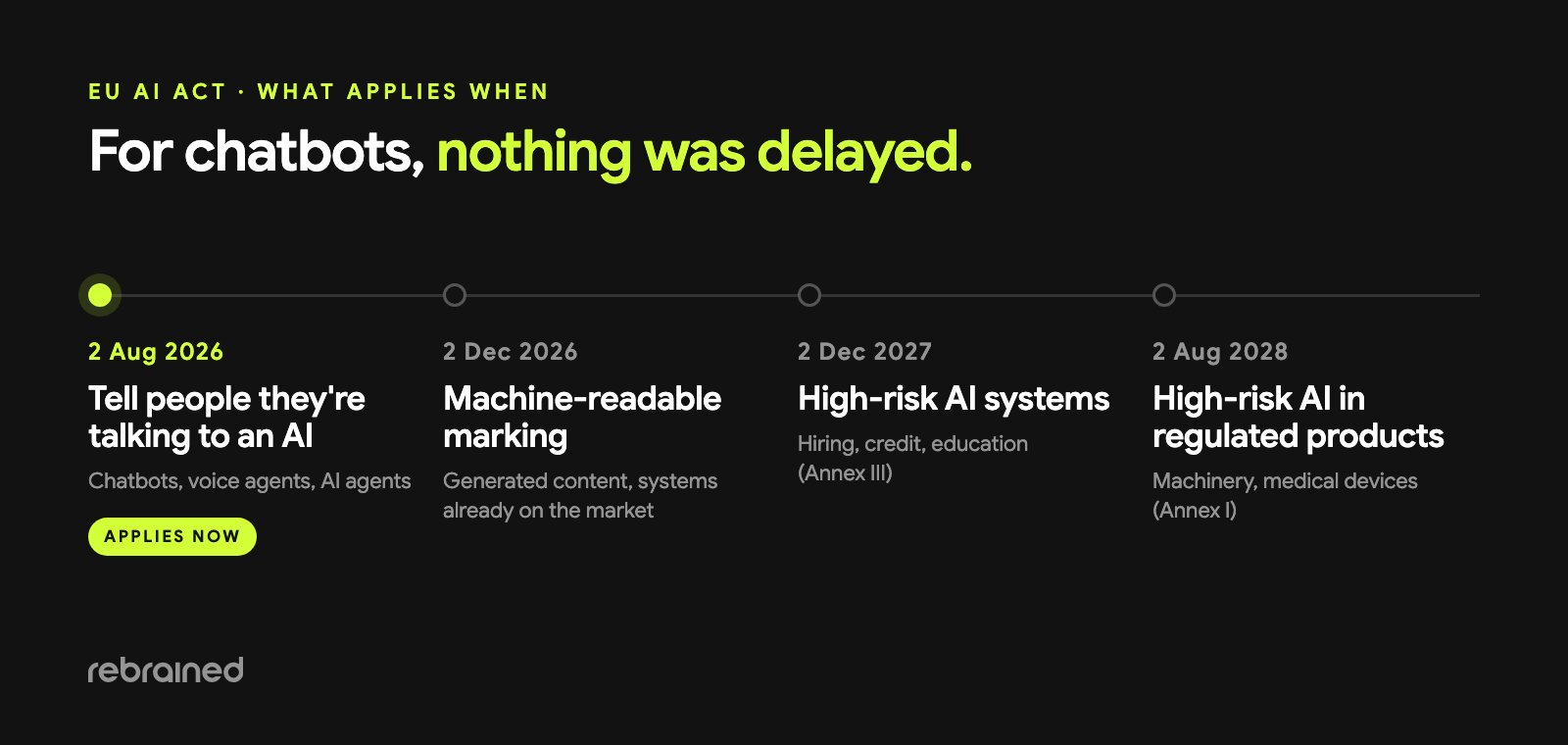
EU AI Act deadlines after the Digital Omnibus. The chatbot and voice agent disclosure rule was not delayed.
Who is responsible
The AI Act splits duties between the provider (who builds the system and puts it on the market under their name) and the deployer (who uses it in their business).
The duty to disclose sits mainly with the provider: the system must be built so that it tells people it is an AI.
In practice that means:
- You use an off-the-shelf chat tool. The vendor must build the disclosure in. Check that it is switched on and that your custom greeting did not remove it.
- You had a chatbot or voice agent built for you and run it under your name. You may well count as the provider yourself. Make sure the disclosure is part of the system, not an afterthought.
Either way, the result your customers see should be the same: they know it is an AI before they share anything.
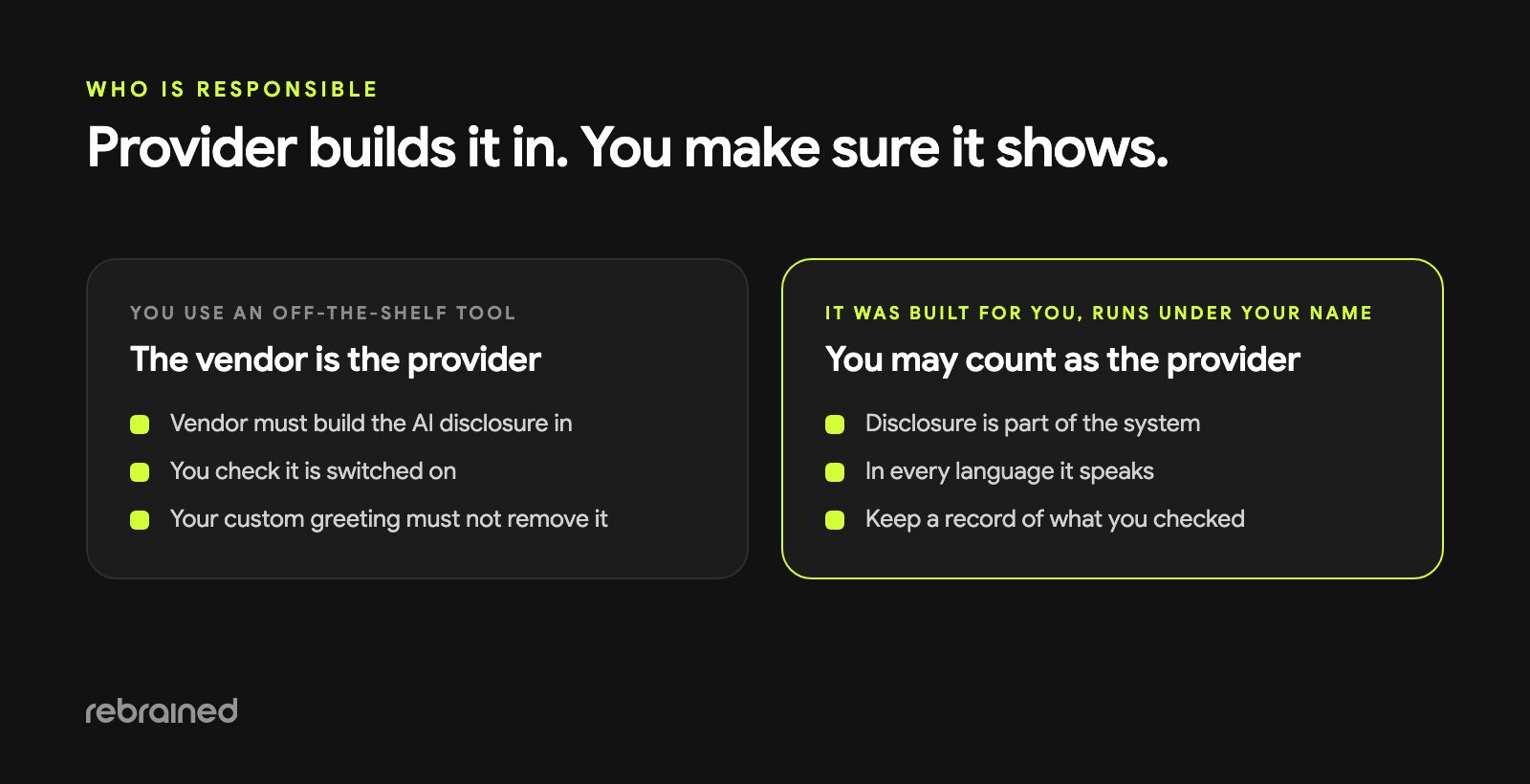
Provider or deployer: who has to build the AI disclosure in, and who has to check it.
“We are not in the EU.” Does it still apply?
Often yes. The AI Act also covers companies outside the EU when the system is used in the EU or its output is used there. A company in Sarajevo whose website chat talks to customers in Germany or Austria should follow the rule.
What good disclosure looks like
Short, first, and in the language of the conversation.
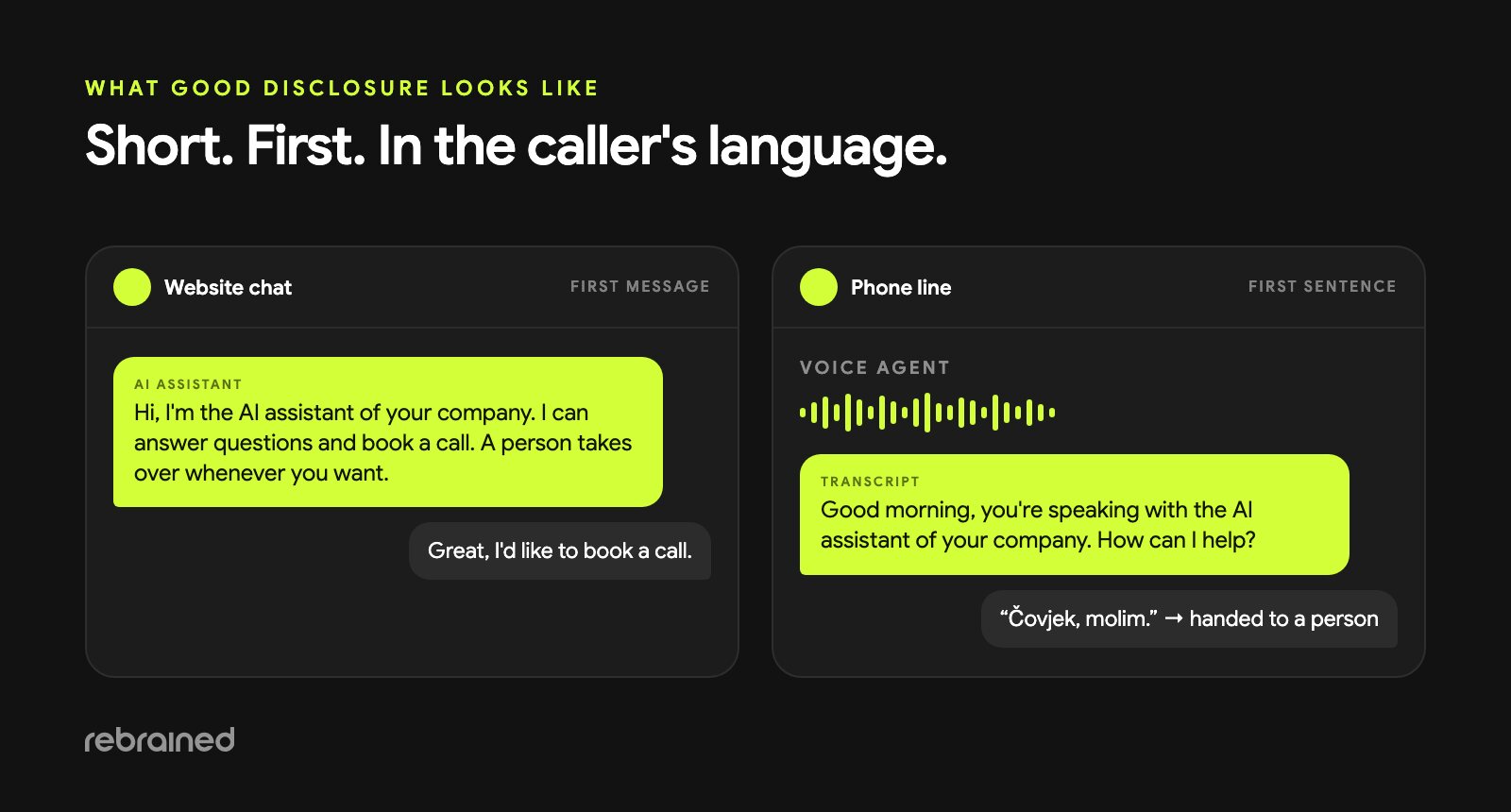
Good disclosure on a website chat and on a phone line: the AI says what it is before anything else.
Website chat, first message:
Hi, I’m the AI assistant of [company]. I can answer questions and book a call. A person from our team takes over whenever you want.
Phone line, first sentence of the voice agent:
Good morning, you’re speaking with the AI assistant of [company]. How can I help?
A handover option. Not strictly part of the rule, but it builds trust: let people reach a human with one word (“person”, “Mensch”, “čovjek”).
What usually does not need a label: an email your team drafted with AI, reviewed and sent themselves. A person is in between, so nobody is talking to an AI directly.
A five-minute checklist
- List every place an AI talks to people: website chat, WhatsApp, phone, email auto-replies.
- Open each one as a customer would. Does the first message say it is an AI?
- Check every language you support, not just English.
- Check that your custom greeting did not overwrite the vendor’s disclosure.
- Write down what you checked and when. If anyone ever asks, you have the record.
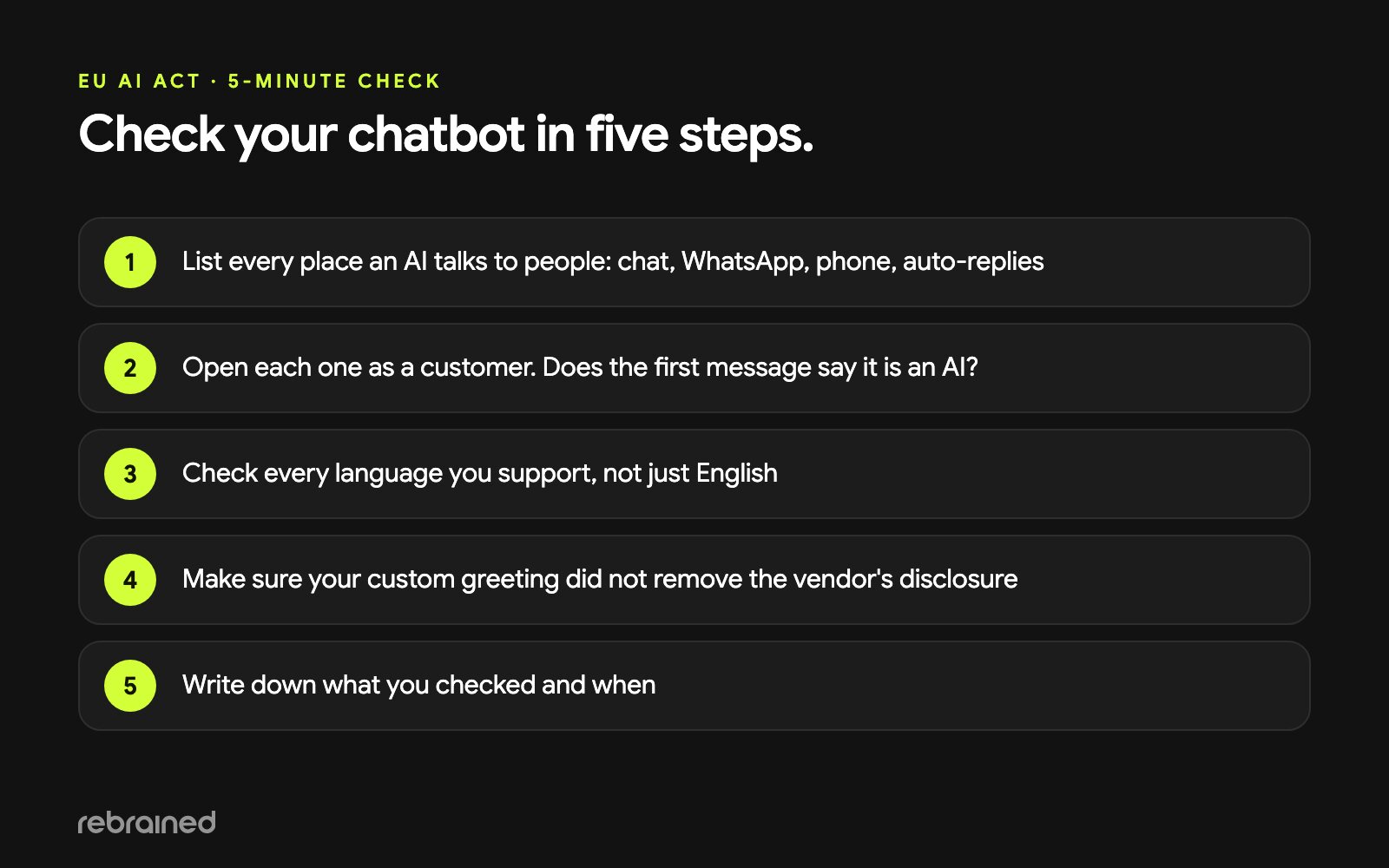
Save this checklist and run it again whenever you change your chatbot or voice agent.
Why it matters beyond the fine
Breaking the transparency rules can cost up to 15 million euros or 3 percent of worldwide turnover, and for small companies the lower of the two counts. National authorities enforce it, not Brussels.
But the bigger cost is trust. People do not mind talking to an AI. They mind finding out later that they were.
How we handle it
Every chat and voice agent we build introduces itself as an AI in its first sentence, in every language it speaks, and offers a human at any point. Nothing it drafts reaches a customer without a person approving it.
If you are not sure what your current setup says, book the free scan. We will check where AI talks to your customers and what it tells them.